Drone Detectors: Types, Fundamentals, and How They Work

As unmanned aerial vehicles (UAVs) become an ever-present threat in both conflict zones and civilian environments, the technology designed to detect them has evolved rapidly. Understanding drone detectors — what they are, how they work, and what their limitations are — is essential knowledge for journalists, security personnel, NGO workers, and anyone operating in high-risk areas.
What Is a Drone Detector?
A drone detector is a device or system designed to identify the presence of a UAV in a given area and alert the user before the drone becomes a direct threat. Unlike interceptor systems, which are designed to neutralize or destroy a drone, detectors are purely passive or semi-passive warning tools — their goal is awareness, not countermeasure. Think of a drone detector as a smoke alarm: it tells you fire is present, but it does not put the fire out.
This distinction is critical. Drone detectors empower individuals and teams to make informed, timely decisions — to take cover, evacuate, or alert others — without requiring any offensive or technically complex response.

How Drone Detectors Work: The Core Principles
Most drone detection systems rely on one or more of the following sensing technologies:
1. Radio Frequency (RF) Detection
The most widely used and accessible detection method. The vast majority of commercial and military drones communicate with their operators via radio signals — transmitting flight commands, telemetry data, and live video. RF detectors continuously scan the electromagnetic spectrum across common drone frequency bands (typically 433 MHz, 915 MHz, 2.4 GHz, and 5.8 GHz) and trigger an alert when a known drone signal pattern is identified.
Strengths: Effective at medium-to-long range; can often identify the drone’s make and model; detects the drone before it is visible or audible; relatively affordable and portable.
Limitations: Cannot detect drones that operate autonomously without active radio communication (pre-programmed flight path with no live signal); may produce false positives in areas with dense Wi-Fi or Bluetooth traffic; fiber-optic controlled drones are invisible to RF detection.
2. Acoustic Detection
Acoustic sensors use microphones and AI-powered audio analysis algorithms to identify the unique sound signatures of drone motors and propellers. Every drone model produces a slightly different acoustic profile, and these systems are trained to distinguish them from background noise — wind, traffic, birds, and other environmental sounds.
Strengths: Works regardless of whether the drone is transmitting a signal; useful as a complementary layer to RF detection; can detect fully autonomous drones.
Limitations: Highly dependent on ambient noise levels — less effective in urban or industrial environments; shorter effective range compared to RF; adverse weather conditions (strong wind, rain) reduce accuracy significantly.
3. Radar Detection
Radar systems emit electromagnetic pulses and analyze the reflected signals to detect moving objects. Specialized micro-Doppler radar can identify the distinctive rotational signature of drone propellers, distinguishing UAVs from birds or other airborne objects.
Strengths: Long detection range; weather-independent; effective against autonomous drones; works day and night.
Limitations: Larger, heavier, and significantly more expensive than RF or acoustic systems; less portable; may require licensing to operate in certain countries due to regulatory frameworks around radar emissions.
4. Optical and Thermal Detection
Camera-based systems — including standard optical cameras and thermal (infrared) imaging — use computer vision and AI to visually identify drones in the sky. Thermal cameras are particularly effective at night, detecting the heat emitted by drone motors and batteries.
Strengths: Provides visual confirmation of the threat; thermal cameras work in complete darkness; can track drone movement in real time.
Limitations: Shorter range in poor weather or low-light conditions for standard cameras; high cost for quality thermal systems; requires processing power and often a fixed installation point.

Types of Drone Detectors
Drone detection systems vary widely in size, complexity, and purpose. They can be broadly divided into three categories:
Portable Personal Detectors
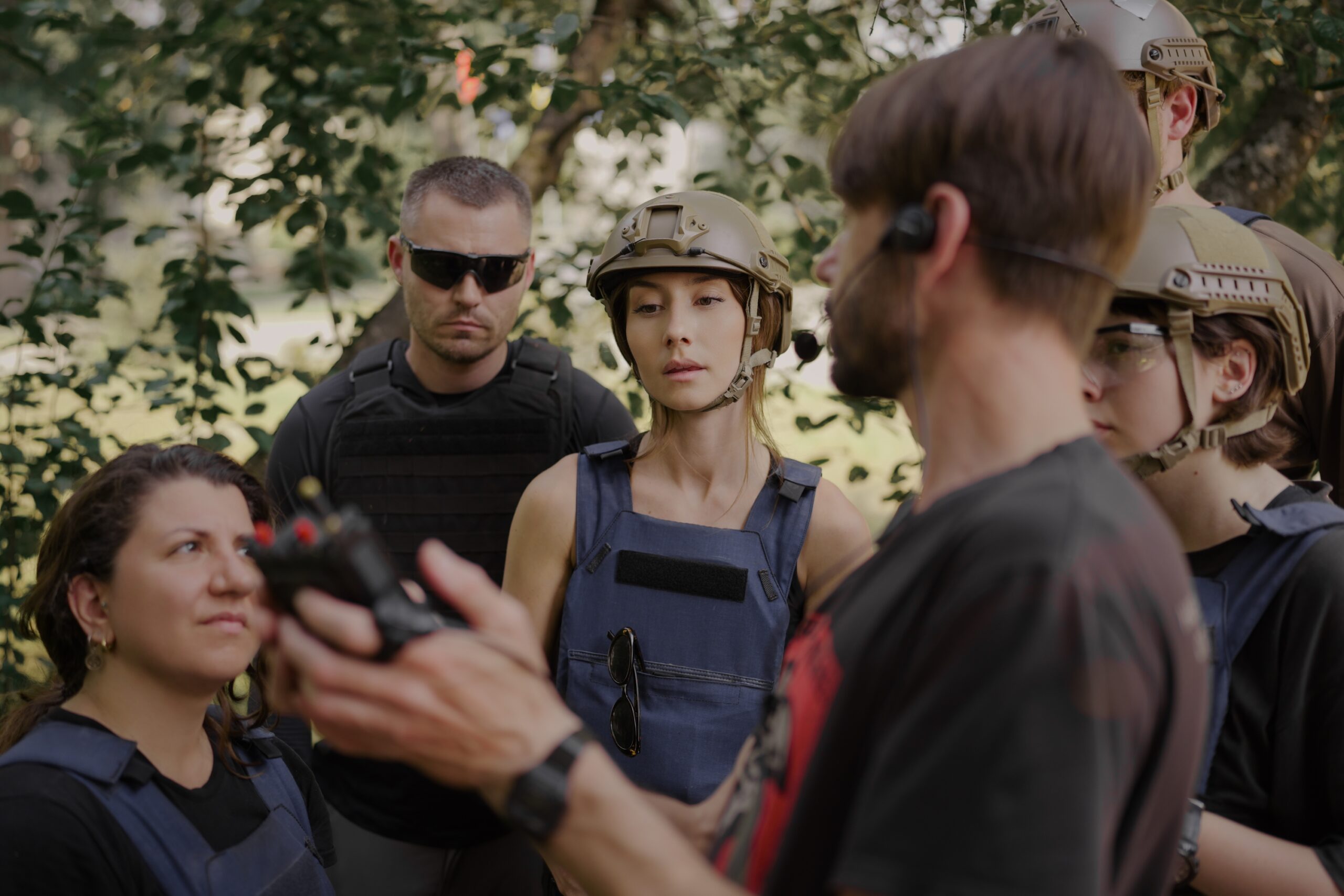
Compact, handheld or wearable devices designed for individual use in the field. These are the most relevant tools for journalists, humanitarian workers, and civilians in high-risk areas. They typically rely on RF detection and provide alerts via sound, vibration, or a visual display on a small screen. Some models can identify the drone type and estimate its direction.
- Typical use case: A journalist or field worker carrying a portable detector while operating near a front line or in an active conflict zone receives an alert and can immediately seek cover — seconds before the drone would have been audible or visible.
Stationary and Semi-Stationary Systems
Designed for protecting a fixed location — a checkpoint, a building, a base of operations, or a humanitarian facility. These systems often combine multiple detection methods (RF + acoustic, or RF + optical) and may cover 360 degrees around a location. They are typically connected to a central monitoring station and can alert an entire team simultaneously.
- Typical use case: A field office in a conflict-affected region uses a perimeter detection system to monitor the airspace around the facility around the clock, allowing staff to receive early warnings and move to shelter.
Integrated Multi-Sensor Detection Networks
Large-scale systems used by military forces, critical infrastructure operators, and government agencies. These networks combine radar, RF, acoustic, and optical sensors across a wide geographic area, feeding data into a unified command-and-control interface. They can track multiple drones simultaneously, predict flight paths, and trigger automatic countermeasures.
- Typical use case: Protection of airports, power plants, government buildings, or large urban areas.
Drone Detectors vs. Video Interception Systems: A Critical Distinction
One of the most common points of confusion — even among security professionals — is the difference between drone detectors and video interception (signal intelligence) devices. While both interact with the electromagnetic signals produced by drones, they serve fundamentally different purposes and operate on entirely different principles.

How Video Interception Works
Video interception devices — sometimes called drone signal analyzers or RF sniffers with decoding capability — go beyond simply detecting a drone’s radio signal. They capture, decode, and display the live video feed being transmitted from the drone’s camera back to its operator. In unencrypted systems (common in older or cheaper commercial drones), this feed can be intercepted with relatively accessible software-defined radio (SDR) equipment.
Why This Distinction Matters
From a practical safety standpoint, a drone detector is what most civilians and field workers need. It tells you: a drone is here, take action now. A video interception system tells you: this is what the drone is seeing — which is valuable for intelligence purposes but does not necessarily trigger the immediate protective response that a detector does.
Furthermore, operating video interception equipment without authorization is illegal in most jurisdictions, as it constitutes unauthorized interception of electronic communications. Drone detectors, by contrast, are generally classified as passive receivers and are legally available for civilian purchase and use in most countries — though regulations vary, and users should always verify local regulations.
Fundamentals of Using a Drone Detector: Practical Guidelines
Using a drone detector effectively requires understanding its behavior and integrating it into a broader safety protocol.
- Know your device’s frequency coverage. Ensure your detector covers the key bands used by drones in your region. In conflict zones, always verify that your device covers military and modified commercial drone frequencies, not just standard consumer bands.
- Minimize your own RF footprint. Active mobile phones, radios, and Wi-Fi hotspots can interfere with detector sensitivity. When operating in a high-threat environment, reduce unnecessary RF emissions around the device.
- Treat every alert as real until proven otherwise. False positives are preferable to ignored warnings. When your detector triggers, follow your pre-established safety protocol immediately — do not pause to investigate or confirm visually first.
- Use detection as part of a layered approach. A detector works best alongside other safety measures: sound awareness, visual scanning, knowledge of cover points, and pre-planned evacuation routes. No single tool is sufficient on its own.
- Maintain and update your device regularly. Drone technology evolves quickly. Many modern detectors receive firmware updates that expand their drone signature databases. Keep your device updated to ensure it can identify the latest UAV models.
- Understand its limitations in your environment. In dense urban areas, RF noise may reduce sensitivity. In open fields, acoustic detection becomes more effective. Know which detection method your device prioritizes and adjust your reliance on it accordingly.
Drone detectors are no longer niche military equipment — they are increasingly essential tools for anyone working in or near conflict zones, and their relevance is growing in civilian security contexts worldwide. Understanding the differences between detector types, their technical principles, and how they differ from more complex interception systems allows users to make informed decisions about which tool is right for their situation.
For hands-on training on drone awareness and detection, explore the Daily Humanity Foundation HEAT + Drones program.

BUILD YOUR SAFETY IMMUNITY WITH US!
more News